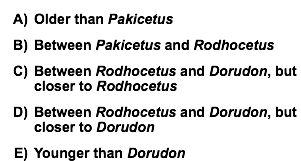
Is the Rodhocetus ankle bone more similar to the cow or Pachyaena?

Powered by responsive-muse

The Department of Geology

The School of Earth, Society, and Environment

College of Liberal Arts and Sciences

Virtual Field Trip Home

Correct! The Rodhocetus ankle bone is a 'double-pulley' and is more similar to the Hippo. Open the packet labeled '5' and check the contents. You should have: A Basilosaurus fossil An Ambulocetus fossil A Pakicetus ankle bone With the discovery of Rodhocetus we have FOSSIL evidence that whales are more closely related to Artiodactyls than Mesonychids. A paleontologist was able to disprove his own hypothesis by finding a new fossil specimen. Remember when Pakicetus was discovered, only the skull was found. Later, new fossil specimens were uncovered showing the legs of Pakicetus. Given what you know now about whale evolution, what shape do you think the ankle bone is? Examine the photo of the Pakicetus ankle bone, where you correct? This suggests that the oldest whale ancestor is Pakicetus. Remove the Pachyaena fossil from your timeline. One of the most powerful aspects of the theory of evolution is that we can make predictions about how organisms changed through time. Examine the Ambulocetus and Basilosaurs fossils. Based on these fossils, how old do you think they are? Place them on the timeline where you think they go, based on their shapes. Where does Basilosaurus go on the timeline? (Multiple Choice, Click Here to Answer) Older than Pakicetus Between Pakicetus and Rodhocetus Between Rodhocetus and Dorudon, but closer to Rodhocetus Between Rodhocetus and Dorudon, but closer to Dorudon Younger than Dorudon

Questions?

Contact Dr. Max Christie

mlc7 (at) illinois.edu